

As engineers in AI and DSP, we treat convolution as a fundamental constant. It’s the bedrock of filtering and the workhorse of deep learning. But for systems requiring high precision and the modeling of real-world physics, our reliance on direct, time-domain convolution is a significant bottleneck. This reliance forces a trade-off between performance and accuracy, often resulting in filters plagued by mathematical artifacts like ripples, wide transition bands, and slow roll-offs.
What if we could discard these trade-offs entirely? What if we could design complex, artifact-free systems based on the first principles of physics that are not only more accurate but also computationally efficient?
This requires moving beyond conventional methods. It requires a framework that can fluently speak the native language of complex systems: Fractional Calculus. This article details how the patented sNoise Research Laboratory (sNRL) framework, Fractional Scaling Digital Signal Processing (FSDSP), achieves this.
The Breakthrough: A Patented Framework for Fractional Control
The core challenge of fractional calculus has always been its implementation. How do you build a practical, tunable system based on non-integer orders of operation?
sNRL’s solution is a patented, foundational platform called Fractional Scaling Digital Signal Processing (FSDSP), which enables the design of advanced Fractional Order Control Systems (FOCS). This is not just a filter; it’s a complete system for modeling a desired response by assembling modular, building-block components. The key innovation, protected by U.S. Patent 10,164,609 B2, is that each component is a modified Laplace function governed by a variable fractional scaling exponent (\beta).
Key Innovations: The \beta and æ Exponents
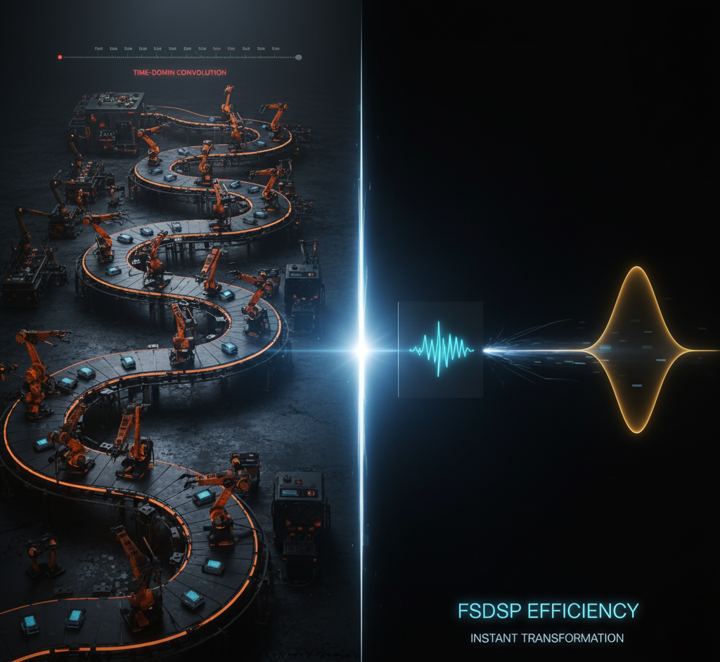
At its heart, FSDSP leverages the Convolution Theorem, executing operations in the complex frequency domain where convolution becomes simple multiplication and then becomes addition in Bode space. FSDSP goes a step further by using \beta as a master control parameter. The transfer function for a foundational fractional operation is expressed as:
H(s) = \dfrac{1}{s^{\frac{\beta}{2}}}This single parameter, \beta, precisely quantifies the order of the operation. By setting its value, we can define any degree of fractional integration (\beta>0) or fractional differentiation (\beta<0) we need. A classic half-integrator, for example, is achieved simply by setting \beta=1. The entire complexity of a fractional-order system is captured in this elegant, tunable scaling exponent.
To provide some practical landmarks, different values of \beta correspond to well-known signal types:
- Blue Noise (\beta=-2): Represents a pure differentiation of white noise, emphasized high frequencies.
- White Noise (\beta=0): Represents pure, uncorrelated randomness.
- Pink Noise (\beta=1): A signature of many natural and self-organizing complex systems.
- Brownian Motion (\beta=2): Represents a pure integration of white noise, also known as a random walk, emphasizing low frequencies.
Furthermore, U.S. Patent 10,727,813 B2 protects a method for orthogonal control over the filter’s magnitude and/or phase using an altitude exponent (æ). This allows us to adjust the gain and phase of a filter response without altering the width of its transition band—a level of granular control unattainable with conventional methods where gain and bandwidth are inextricably linked. The altitude exponet æ is wrapped around an FSDSP equation as:
H(s) = \left[\dfrac{K}{s^{\frac{\beta}{2}}}\right]^æThis equation represents one of the foundational building blocks within the FSDSP framework. Here, K is a multiplier for adjusting DC offsets between processing windows, while the two exponents \beta and æ provide dual, orthogonal control over the system. The scaling exponent (\beta) defines the fundamental order of the operation; by simply changing its value, this single equation can perform any degree of fractional integration (\beta > 0) or fractional differentiation (\beta < 0) on a signal. After the core fractional properties are set, the altitude exponent (æ) acts as a meta-operation, allowing the gain and phase of the entire frequency response to be adjusted with surgical precision without needing to recalculate the base filter.
This frequency-domain approach is also profoundly more efficient. A traditional time-domain FIR filter has a computational complexity of O(N \cdot M), where N is the signal length and M is the filter length (or number of taps). For systems with long memory, M must be very large, making the convolution process computationally expensive. FSDSP’s FFT-based method, however, has a complexity of O(N \log N). This is a dramatic reduction in computational cost, enabling real-time performance on complex systems where it was previously intractable.
graph TD
A[Input Signal] --> F{FSDSP Filter};
subgraph Controls
B["β (Scaling Exponent)"] -- "Controls Filter Order / Slope" --> F;
C["æ (Altitude Exponent)"] -- "Controls Filter Gain / Height" --> F;
end
F --> G[Clean Output Signal];

style F fill:#0077b6,stroke:#fff,stroke-width:2px,color:#fff
From Theory to Practice: Patented Applications
This patented framework is not just a theoretical construct; it enables a range of powerful, real-world capabilities that are themselves novel inventions.
1. Precision Signal Generation
Conventional noise generators are imperfect. FSDSP allows us to correct for these imperfections. As detailed in U.S. Patent 9,740,662 B2, we can measure the inherent scaling exponent of an input signal and precisely adjust the FOCS transfer function. This patented compensation method allows us to generate “pure,” mathematically perfect standardized noise signals and synthetic data series that are statistically identical to natural stochastic phenomena.
2. Unprecedented Design Flexibility
FSDSP allows for a “hybrid” approach to filter design. As protected by U.S. Patent 10,169,293 B2, we can use different component forms for modifying magnitude and phase independently. This gives engineers unprecedented flexibility to craft complex frequency responses tailored to the exact needs of their system, rather than being constrained by the limitations of standard filter types.
3. Advanced Secure Communications
The same patent also protects a novel application in information security. By using mathematically related filter components, a payload can be deeply embedded into a noise-based transmission signal. This signal can only be decoded when synchronized with a separate key signal, providing a new method for noise-based secure communications.
A New Toolbox for Principled AI
FSDSP is more than a faster way to filter a signal. It is a fundamentally new, patented toolkit for building models based on the true fractional-order dynamics of real-world systems. The framework moves beyond the brute-force approximation of time-domain convolution to elegant and exact mathematical modeling.
For engineers and researchers building the next generation of AI for robotics, aerospace, and autonomous control, this represents a paradigm shift. It is an opportunity to build systems that are not only more efficient and precise but also inherently explainable and physically realistic.
The sNoise Research Laboratory is looking for collaborators and pioneers to explore this new frontier. If you are an engineer, researcher, or organization pushing the boundaries of what’s possible in AI and control systems, we invite you to connect.

Dr. Jeffrey Smigelski is the founder of the sNoise Research Laboratory (sNRL) and the sole inventor of the patented Fractional Scaling Digital Signal Processing (FSDSP) framework. FSDSP is a powerful computational implementation of Fractional Calculus, which his work identified as the fundamental mathematics of natural systems. His pioneering research established the connection between empirically measured scaling exponents and operational fractional calculus, creating a new paradigm to precisely model, filter, synthesize, and interact with the physics of real-world systems through an equation-based framework, leading to advancements in signal processing, fractional order control systems, and AI.